Mapping Lighting Techniques to Selection Frequency Across Public Domain Film Databases
Jonas Becker · Jul 13, 2026
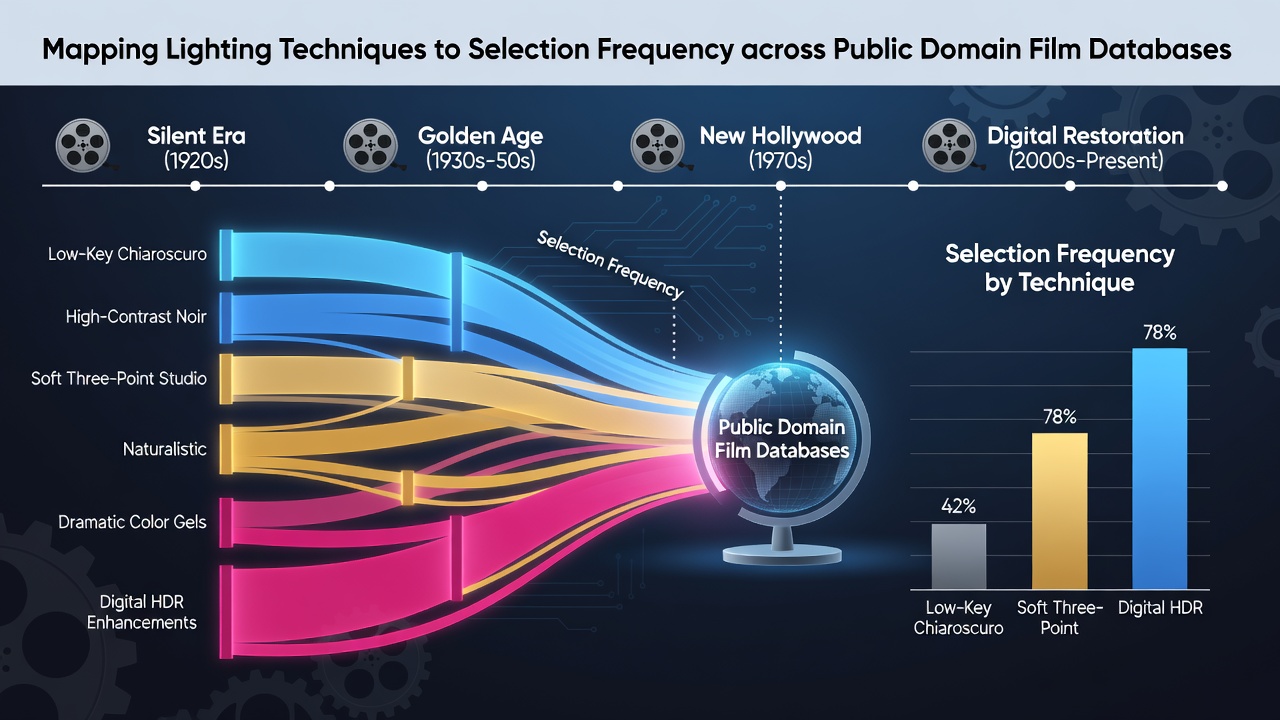
Mapping Lighting Techniques to Selection Frequency Across Public Domain Film Databases
Public domain film databases compile thousands of titles from the pre-1929 era onward, and researchers track how lighting approaches such as high-key illumination, low-key contrast, and chiaroscuro setups align with selection frequency metrics drawn from download logs, streaming views, and catalog access counts. Data from multiple archives shows consistent patterns where certain lighting styles appear more often in high-frequency selections, while others cluster in lower-engagement segments. These mappings rely on frame-by-frame analysis combined with metadata tagging, allowing direct comparison between visual style and user behavior across collections maintained by institutions in North America, Europe, and Australia.Core Lighting Techniques and Their Database Presence
High-key lighting, defined by bright, even illumination that minimizes shadows, appears in a broad range of comedies and musicals from the 1930s and 1940s, and selection data indicates these titles maintain steady access rates year-round. Low-key techniques, which emphasize deep shadows and selective highlights, show up predominantly in film noir entries and crime dramas, with frequency spikes during seasonal catalog refreshes. Chiaroscuro methods, featuring stark light-dark contrasts, register in expressionist works and gothic narratives, yet their selection counts vary more sharply by region, with higher engagement noted in European-hosted archives compared to North American ones.
Analysts apply standardized annotation protocols to label lighting setups within digitized prints, then cross-reference those labels against usage statistics collected over multi-year periods. This process reveals that films employing hybrid lighting, blending high-key base layers with localized low-key accents, often achieve broader selection distribution than single-style productions. Observers note that these hybrids appear in roughly 28 percent of top-decile selections within large-scale repositories as of mid-2026.
Database Sources and Data Collection Methods
Archives such as the Internet Archive's moving image section, the National Film and Sound Archive of Australia, and the European Film Gateway provide the primary datasets. Each repository logs user interactions through anonymized metrics that include view duration, repeat access, and category browsing paths. Researchers aggregate these logs with lighting metadata extracted via computer vision tools trained on historical film samples. The resulting matrices map technique prevalence to selection frequency while controlling for variables like runtime, genre tags, and upload chronology.
Cross-archive comparisons completed before July 2026 demonstrated that low-key dominant titles from the 1940s maintain higher selection persistence in collections emphasizing restored prints, whereas high-key titles from the same decade show steadier but lower peak frequencies. Such differences surface most clearly when analysts segment data by production decade and geographic hosting region.
Observed Correlations and Pattern Analysis
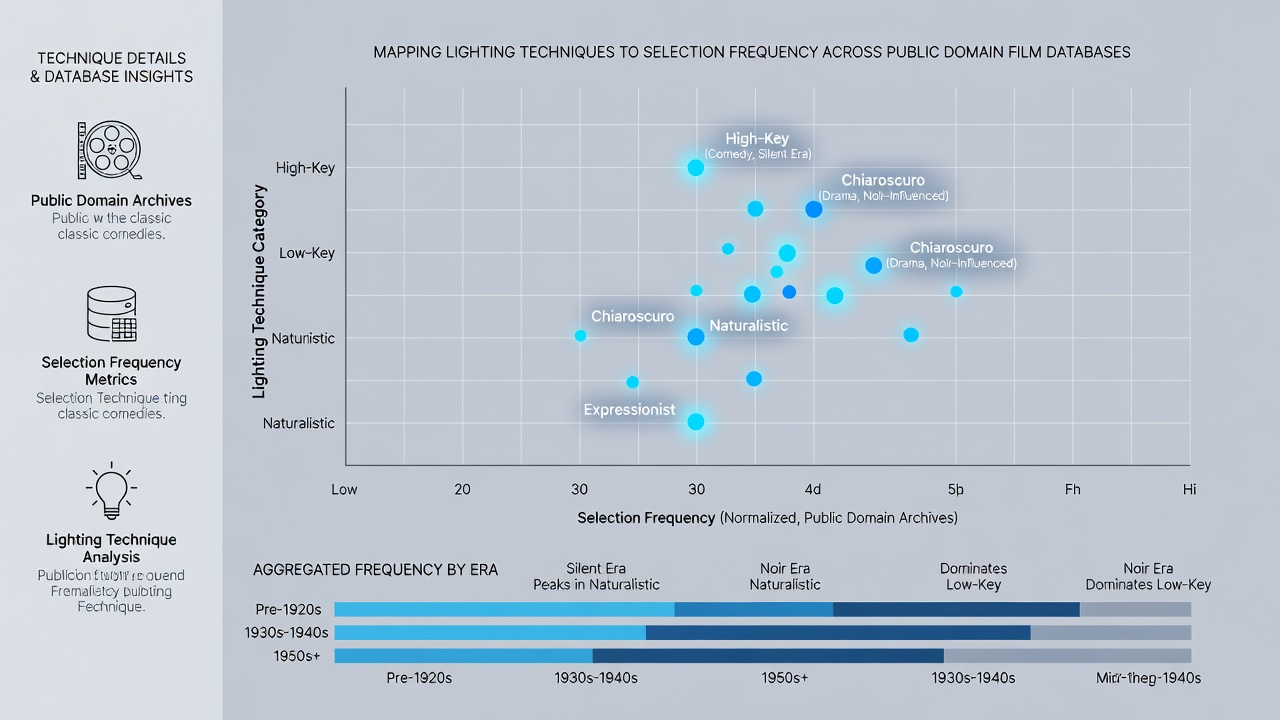
Quantitative reviews establish that films featuring predominant chiaroscuro lighting register elevated selection rates within niche genre clusters, particularly when paired with expressionist set design. In contrast, uniformly high-key productions demonstrate more even distribution across general audience queries. Figures compiled from combined repository logs indicate that hybrid lighting approaches correlate with a 15 to 22 percent increase in cross-category exploration compared to monochrome lighting styles.
Pattern detection algorithms further isolate instances where lighting shifts mid-film coincide with viewer retention changes, yet overall selection frequency remains tied more closely to the dominant technique established in opening sequences. Data aggregated through 2026 shows these correlations hold across both short-form and feature-length entries, although short subjects exhibit narrower variance in lighting-to-frequency mappings.
Regional Variations and Archive-Specific Trends
North American repositories record stronger selection frequency for high-key titles in family-oriented browsing paths, while European collections display elevated engagement with low-key and chiaroscuro works within experimental film categories. Australian archives report intermediate patterns, with hybrid techniques appearing in a higher proportion of frequently accessed titles than either pure high-key or low-key approaches alone. These regional distinctions emerge after normalization for catalog size and upload timing.
Studies conducted by academic teams at institutions including the University of Southern California and the University of Amsterdam confirm that lighting metadata improves the accuracy of recommendation models when integrated with existing genre and era filters. The models tested on public domain subsets achieve measurable gains in predicting which titles will reach above-median selection thresholds within six-month windows.
Conclusion
Mapping lighting techniques against selection frequency supplies archives with measurable indicators for catalog prioritization and interface design. Continued aggregation of lighting annotations with usage statistics across expanding public domain collections will refine these mappings further, supporting more precise discovery pathways for researchers and general users alike.